O Outro interno odiado: racismo e (in)segurança ontológica nos discursos da política externa brasileira
DOI:
https://doi.org/10.30612/rmufgd.v12i24.16746Palavras-chave:
Raça e Racismo, Política Externa Brasileira, Segurança Ontol´ógicaResumo
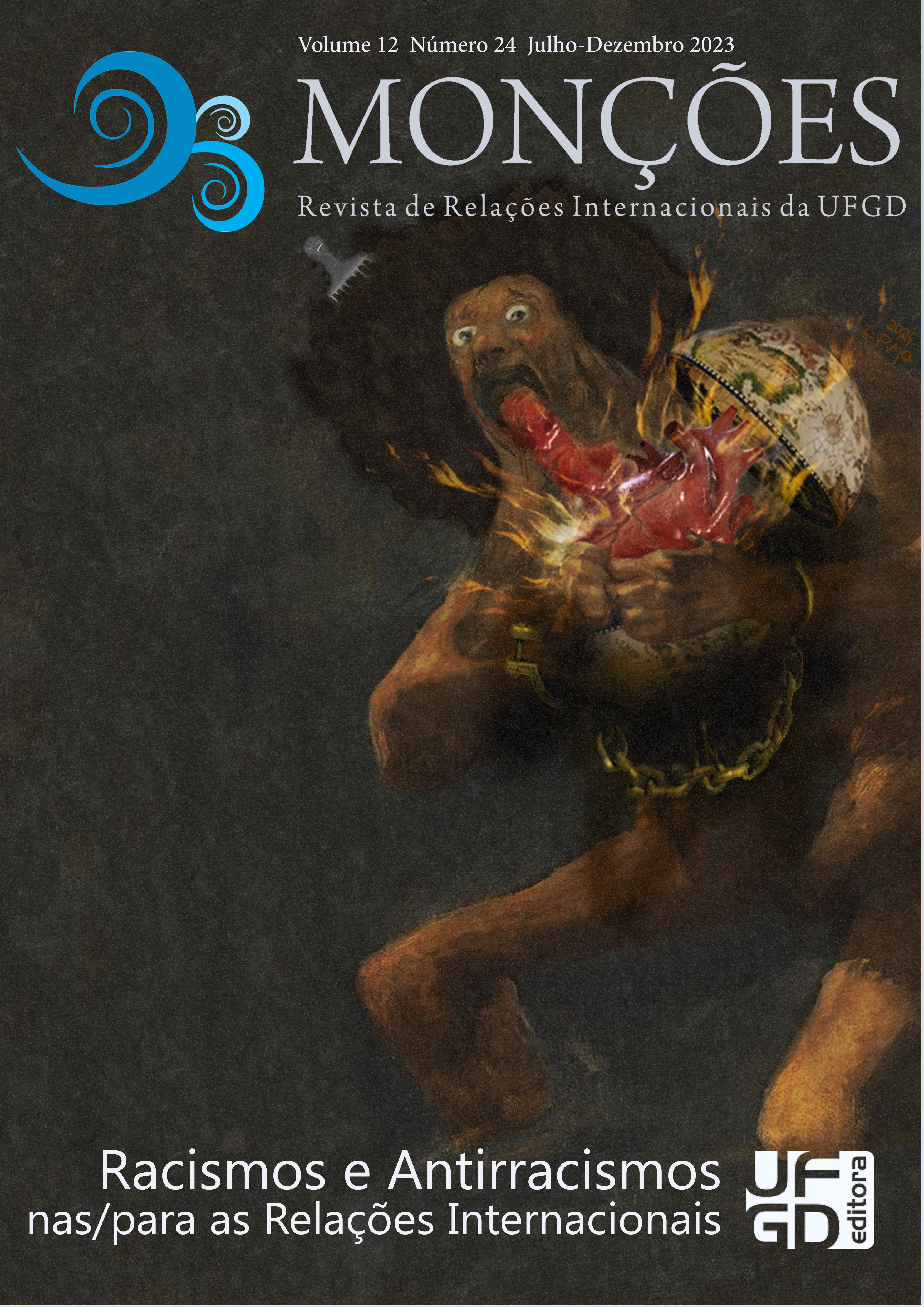
A partir de diálogos mais aprofundados entre a política externa brasileira (PEB) e lentes analíticas pós-estruturalistas (principalmente inspiradas pela psicanálise lacaniana) e pós-coloniais, bem como tendo em vista a lacuna em torno de temas de raça e racismo nos estudos da PEB, este trabalho busca posicionar a questão racial, especialmente o mito da democracia racial, como o verdadeiro alicerce das leituras da identidade brasileira, bem como dos cálculos de preferências e interesses de suas elites. Entendendo “política externa” como uma prática discursiva de construção de fronteiras, o conceito de (in)segurança ontológica é central neste artigo. Privadas do status de cidadãs, as populações negras e indígenas foram (e são) excluídas das narrativas identitárias que definem quem e para quem é o Brasil, de modo que a estabilidade da identidade do brasileiro prevê, necessariamente, a insegurança ontológica (e todas as violências que a ela acompanham) de grande parte da população que habita em seu território. Ao mesmo tempo, faz-se necessário interrogar as condições de possibilidade que permitem, de forma ambígua, que sejam sustentados discursos de Política Externa que afirmam exatamente o contrário, dando centralidade ao componente racial negro e indígena na identidade (inter)nacional do país, mascarando o encarceramento em massa e o genocídio aos quais essas populações são submetidas.
Downloads
Referências
ALFONSO, Daniel A. Bolsonaro’s take on the ‘absence of racism’ in Brazil. Race and Class. v. 00, n. 0, pp 1-17, 2019.
ALTEMANI, H. (2005) Política Externa Brasileira. São Paulo: Saraiva, 2005. 289 p
AMORIM, Camille; SILVA, André Luiz Reis. O Itamaraty e o Movimento Negro: interesses, ideias e práticas nas relações Brasil-África. Revista Brasileira de Ciência Política. n. 35, 2021. DOI: https://doi.org/10.1590/0103-3352.2021.35.244677
ANIEVAS, A; MANCHANDA, N; SHILLIAM, R. (2015). Confronting the global colour line: an introduction. ANIEVAS, A; MANCHANDA, N; SHILLIAM, R. (2015). In: Race and Racism in International Relations: confronting the global colour line. pp. 1-15. DOI: https://doi.org/10.4324/9781315857299
BERENSKOETTER, Felix. Parameters of a National Biography. European Journal of International Relations. [s.l.], v. 20, n. 1, p. 262-88, 2014. DOI: https://doi.org/10.1177/1354066112445290
BHABHA, H. (1990) The Third Space: Interview with Homi Bhabha, in Rutherford, J. (ed) Identity, Community, Culture, Difference, London, Lawrence & Wishart, 1990.
BIONDI, L. (s.a.) Imigração. In: Centro De Pesquisa E Documentação De História Contemporânea Do Brasil. Dicionário Histórico Biográfico Brasileiro. Disponível em: <https://cpdoc.fgv.br/sites/default/files/verbetes/primeira-republica/IMIGRA%C3%87%C3%83O.pdf > Acesso em: 20 jan. 2023.
BROWNING, C.S. (2015). Nation Branding, National Self-Esteem, and the Constitution of Subjectivity in Late Modernity. Foreign Policy Analysis. n.11, pp.195–214 DOI: https://doi.org/10.1111/fpa.12028
BROWNING, C.S.; JOENNIEMI, P.(2017) Ontological security, self-articulation and the securitization of identity. Cooperation and Conflict. Vol 52, Issue 1. DOI: https://doi.org/10.1177/0010836716653161
BOLSONARO, J. (2018) Discurso transmitido na Avenida Paulista. 22 de Outubro , 2018.
CAMPBELL, D. (1992) Writing Security: United States Foreign Policy and the Politics of Identity. Minneapolis: University of Minnesota Press. 269 p.
CARLSNAES, Walter. Actors, structures and foreign policy analysis. In: Smith, Steve, Hadfield, Amelia, et al. Foreign policy: theories, actors, cases. Oxford: Oxford University Press, 2008.
CERVO, A. L. (2008). Inserção internacional: formação dos conceitos brasileiros. 1. ed. São Paulo: Saraiva, 2008. v. 1. 297p .
CICALO, A. (2013) From Racial Mixture to Black Nation: Racialising Discourse in Brazil’s African Affairs. Bulletin of Latin American Research. 33, n.1 DOI: https://doi.org/10.1111/blar.12063
CROFT, S. and VAUGHAN-WILLIAMS, N. (2017) Fit for Purpose? Fitting Ontological Security Studies “into” the discipline of International Relations: Towards a Vernacular Turn. Cooperation and Conflict, 52, n.1 DOI: https://doi.org/10.1177/0010836716653159
DARBY, P. and PAOLINI, A (1994): “Bridging International Relations and Postcolonialism”, Alternatives. DOI: https://doi.org/10.1177/030437549401900304
EBERLE, J. (2017) Narrative, desire, ontological security, transgression: fantasy as a factor in international politics. Journal of International Relations and Development. v. 22 n.4, p. 1-26, Maio, 2017. DOI: https://doi.org/10.1057/s41268-017-0104-2
EDKINS, J.; PIN-FAT, V. “The Subject of the Political”. In: EDKINS, J. PERSRAM, N., PIN-FAT, V. (eds): Sovereignty and Subjectivity. London: Lynne Rienner Publishers, pp.1-18. DOI: https://doi.org/10.1515/9781685857097-003
EPSTEIN, C. (2010) Who speaks? Discourse, the subject and the study of identity in international politics. European Journal of International Relations. 17 (2) pp.327-350 DOI: https://doi.org/10.1177/1354066109350055
ESTEVES, P.; FONSECA, J. M. ; GOMES, G. Z. (2016) Is there a Brazilian solution for every African problem? Brazilian Health Cooperation in Angola (2006-2015). Carta Internacional (USP), v. 11, p. 152, 2016. DOI: https://doi.org/10.21530/ci.v11n2.2016.561
FANON, F. (1961). The Wretched of the Earth. Grove Press.
FERNANDES, M.; GAMA, C.F.P.S. (2016) Modernization in-between: The ambivalent role of Brazil in contemporary peacebuilding efforts in Africa. In: KENKEL, K.M. and CUNLIFFE, P. Brazil as a Rising Power: Intervention Norms and the Contestation of Global Order. New York: Routledge. pp.65-80.
FERREIRA, R.F. (2002) O Brasileiro, o racismo silencioso e a emancipação do afrodescendente. Psicologia e Sociedade, 14 (1): 69-86; jan/jun. DOI: https://doi.org/10.1590/S0102-71822002000100005
GIDDENS, A. (1991). The Consequences of Modernity. Polity Press. 186p. GUZZINI, S. (ed.) (2012). The Return of Geopolitics in Europe? Social Mechanisms and Identity Crises. Cambridge Studies in International Relations.
GONZALEZ, Lélia. A categoria político-cultural de amefricanidade. Tempo brasileiro. Rio de Janeiro, v. 92, n. 93, p. 69-82, 1988.
GUZZINI, S. The return of geopolitics in Europe? Social mechanisms and foreign policy identity crises. Cambridge: Cambridge University Press, 2012. DOI: https://doi.org/10.1017/CBO9781139225809
HALL, S. (2017) The Fateful Triangle: Race, Ethnicity, Nation. Cambridge, Massachusetts: Harvard University Press. 229p. DOI: https://doi.org/10.4159/9780674982260
HANSEN, L. (2006) Security as Practice: Discourse analysis and the Bosnian War. London and New York: Routledge. 239p.
HERMANN, Charles F. Changing course: when governments choose to redirect foreign policy. International Studies Quarterly, v. 34, n. 1, p. 3-21, 1990. DOI: https://doi.org/10.2307/2600403
HENDERSON, E.A. Hidden in plain sight: Racism in international relations theory. In: ANIEVAS, A; MANCHANDA, N; SHILLIAM, R. (2015). Race and Racism in Internacional Relations: confronting the global colour line. pp. 19-43.
KINNVALL, C. (2017) Feeling ontologically (in)secure: States, traumas and the governing of gendered space. Cooperation and Conflict. Vol 52, Issue 1. DOI: https://doi.org/10.1177/0010836716641137
KINNVALL, C. and MITZEN, J. (2017) An introduction to the special issue: Ontological securities in world politics. Cooperation and Conflict. Vol 52, Issue 1, pp. 3 – 11. Available at: https://doi.org/10.1177/0010836716653162 DOI: https://doi.org/10.1177/0010836716653162
KRISHNA, S. (2002) In one innings: National identity in postcolonial times. In: CHOWDRY, G. and NAIR, S. Power, Postcolonialism and International Relations: Reading race, gender and class. Routledge, 324p.
LAFER, Celso. A identidade internacional do Brasil e a Política Externa Brasileira: Passado, Presente e Futuro. 2ª Edição. São Paulo: Perspectiva, 2014.
LIMA, M. R. S. (2005) A política externa brasileira e os desafios da cooperação Sul-Sul. Revista Brasileira de Política Internacional,v. 48, n.1. 2005. p. 24-59. DOI: https://doi.org/10.1590/S0034-73292005000100002
MBEMBE, A. (2017) Critique of Black Reason. Durham: Duke University Press. 215p. DOI: https://doi.org/10.2307/j.ctv125jgv8
MESQUITA, Gustavo. The Rise and Fall of the Anti-Racism Agenda in Brazil from Lula to Bolsonaro. BRASILIANA: Journal for Brazilian Studies. v. 10 n. 1 (2021). DOI: https://doi.org/10.25160/bjbs.v10i1.126311
MILLS, C. (1999) The Racial Contract. Ithaca: Cornell University Press.
NANDY, A.(1989) The Intimate Enemy: Loss and Recovery of Self under colonialism, India, 1989.
NASCIMENTO, Abdias. O Quilombismo: Documentos de uma militância pan-africanista. 3ª ed. revisada. São Paulo: Perspectiva, 2019.
OLIVEIRA, Ananda Vilela da Silva. Epistemicídio e a academia de Relações Internacionais: o Projeto UNESCO e o pensamento afrodiaspórico sobre o Brasil e seu lugar no mundo. Dissertação (Mestrado em Relações Internacionais) – Instituto de Relações Internacionais, Pontifícia Universidade Católica do Rio de Janeiro, Rio de Janeiro, 2020.
PAULA, F.R.de (2016) Brazil comes to the future: Living time and space in the International Orders of Competition. Doctoral thesis. Virginia Polytechnic Institute and State University – Doctorate of Philosophy in Social, Political, Ethical and Cultural Thought.
PINHEIRO, L. Política Externa Brasileira. Rio de Janeiro: Jorge Zahar, 2004. (Coleção Descobrindo o Brasil).
PINHEIRO, Letícia. Traídos pelo desejo: um ensaio sobre a teoria e a prática da política externa brasileira contemporânea. Contexto internacional, v. 22, n. 2. p.305-335, 2000.
PUTNAM, Robert D. Diplomacia e Política Doméstica. A Lógica dos Jogos de Dois Níveis. Rev. Sociol. Polít., Curitiba, v. 18, n. 36, p. 147-174, 2010. DOI: https://doi.org/10.1590/S0104-44782010000200010
QUIJANO, Aníbal. Colonialidade do poder, Eurocentrismo e América Latina. In: QUIJANO, Aníbal. A colonialidade do saber: eurocentrismo e ciências sociais. Perspectivas latinoamericanas. Buenos Aires: CLACSO, Consejo Latinoamericano de Ciencias Sociales, 2005.
RIBEIRO, Djamila. (2018) Quem tem medo do feminismo negro? Companhia das letras, 120p.
SANTOS, B. S. (2002) Between Prospero and Caliban: Colonialism, Postcolonialism, and Inter-identity. Luso-Brazilian Review, v.39, n.2. pp.9-43 DOI: https://doi.org/10.3368/lbr.39.2.9
SANTOS, Camila dos; GOMES, Maíra Siman; FERNÁNDEZ, Marta. ‘Two Brazils’: Renegotiating Subalternity Through South-South Cooperation in Angola. Brazilian Political Science Review, v. 13, 2019. DOI: https://doi.org/10.1590/1981-3821201900010007
SANTOS, L. BNDES: internacionalização de empresas e o subimperialismo brasileiro. GEOUSP Espaço e Tempo (Online), [S. l.], v. 22, n. 1, p. 115-137, 2018. DOI: 10.11606/issn.2179-0892.geousp.2018.115940. Disponível em: https://www.revistas.usp.br/geousp/article/view/115940. Acesso em: 30 jan. 2023. DOI: https://doi.org/10.11606/issn.2179-0892.geousp.2018.115940
SARAIVA, Miriam Gomes. The democratic regime and the changes in Brazilian foreign policy towards South America. Brazilian Political Science Review, v. 14, 2020. DOI: https://doi.org/10.1590/1981-3821202000030001
SARAIVA, Miriam Gomes. As estratégias de cooperação Sul-Sul nos marcos da política externa brasileira de 1993 a 2007. Revista Brasileira de Política Internacional. v. 50, n. 2, p. 42-59, 2007. DOI: https://doi.org/10.1590/S0034-73292007000200004
SOUZA, J. (2017) A elite do atraso: da escravidão à lava jato. Rio de Janeiro: Leya, 239p.
STAVRAKAKIS, Yannis. Lacan and the political. London and New York: Routledge, 1999.
STAVRAKAKIS, Yannis. The Lacanian Left. Edinburgh: Edinburgh University Press, 2007. DOI: https://doi.org/10.1515/9780748629077
SOLOMON, Ty. The politics of subjectivity in American foreign policy discourses. Minneapolis: University of Michigan Press, 2015. DOI: https://doi.org/10.3998/mpub.5031921
TRAPP, Rafael Petry. O antirracismo no Brasil e a Conferência de Durban: identidades transnacionais e a constituição da agenda política do Movimento Negro (1978-2010). Revista Cadernos do Ceom v. 24, n. 35, 2011.
VIEIRA, M.A. (2017) (Re-)imagining the ‘Self’ of Ontological Security: The Case of Brazil’s Ambivalent Postcolonial Subjectivity. Millennium: Journal of International Studies. pp.1-23 DOI: https://doi.org/10.1177/0305829817741255
VIGOYA, M. V. As cores da masculinidade: Experiências intersseccionais e práticas de poder na Nossa América.
VIGEVANI, T. CEPALUNI, G. (2007) A Política Externa de Lula da Silva: A Estratégia da Autonomia pela Diversificação. Contexto Internacional. Rio de Janeiro, v. 29, n.2. p.273- 335, jul./dez. 2007. DOI: https://doi.org/10.1590/S0102-85292007000200002
ZEHFUSS, M. (2001). Constructivism and Identity: A Dangerous Liaison. European Journal of International Relations 7(3): 315-348. DOI: https://doi.org/10.1177/1354066101007003002
Downloads
Publicado
Como Citar
Edição
Seção
Licença
- Os autores e autoras mantêm os direitos autorais e concedem à revista o direito de primeira publicação, com o trabalho simultaneamente licenciado sob a Creative Commons Atribuição-NãoComercial-CompartilhaIgual 3.0 Brasil. que permite o compartilhamento do trabalho com reconhecimento da autoria e publicação inicial nesta revista.
- Autores e autoras têm autorização para assumir contratos adicionais separadamente, para distribuição não-exclusiva da versão do trabalho publicada nesta revista (ex.: publicar em repositório institucional ou como capítulo de livro), com reconhecimento de autoria e publicação inicial nesta revista.
- Autores e autoras têm permissão e são estimulados a publicar e distribuir seu trabalho online (ex.: em repositórios institucionais ou na sua página pessoal) a qualquer ponto antes ou durante o processo editorial, já que isso pode gerar alterações produtivas, bem como aumentar o impacto e a citação do trabalho publicado, porém invariavelmente com o reconhecimento de autoria e publicação inicial nesta revista.