Contradictions, weaknesses and correct decisions of the landmarks of regularization of venezuelans in Brazil
DOI:
https://doi.org/10.30612/rmufgd.v8i16.9845Keywords:
Venezuelans, Brazil, Migratory Legislation, Refuge, Human Rights.Abstract
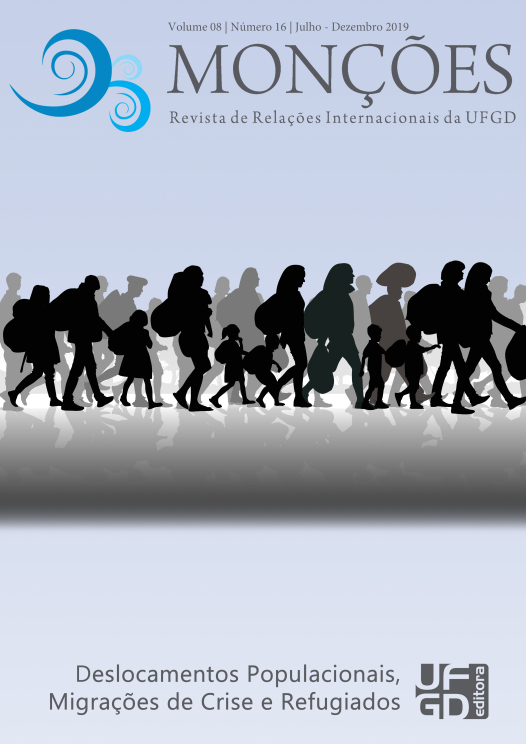
This article analyzes the way in which the Brazilian State has dealt with the Venezuelan migratory flow in order to carry out a critical analysis in the normative construction of responses to the flows that go to Brazil, through the confrontation of this state construction with the effectiveness of the measures and the compliance with international Human Rights. We will first analyze the Venezuelan migration in Roraima, in order to relate this flow to the legal framework of the Statute of Foreigners, new migration law and the Refugee Statute, as well as the emergency norms for the subject, such as Resolution 126 / 2017 of the CNIg, as well as Interministerial Order No. 9. Finally, it will be analyzed whether the legal norms of protection to the migrant in Brazil are consistent with the expectations promoted by Human Rights enshrined in international diplomas. The article concludes that the recognition of the serious and widespread violation of human rights in Venezuela, although belated, was adequate to the international commitments assumed by Brazil.
Downloads
References
ABRAHÃO, Bernardo A. Solicitação de refúgio como estratégia migratória dos venezuelanos em Roraima nos anos de 2014 a 2017. Dissertação de Mestrado. Programa de Pós-Graduação em Sociedade e Fronteiras. Universidade Federal de Roraima, 2019.
BETTS, Alexander. Survival Migration: A New Framewor. Global Governance, v. 16, 2010.
BETTS, Alexander. Survival migration: failed governance and the crisis of displacement, London: Conner University Press, 2012.
BAENINGER, Rosana; SILVA, João Carlos Jarochinski (coordenadores). Migrações Venezuelanas. Campinas, SP: Núcleo de Estudos de População "Elza Berquó" – NEPO/UNICAMP, 2018, p. 158-163.
DEL VECCHIO, Victor Antonio; ALMEIDA, Vitor Bastos Freitas. Panorama do fluxo migratório de venezuelanos no brasil e américa latina. In: BAENINGER, Rosana; SILVA, João Carlos Jarochinski (coordenadores). Migrações Venezuelanas. Campinas, SP: Núcleo de Estudos de População "Elza Berquó" – NEPO/UNICAMP, 2018, p. 158-163.
FERNANDES, Duval Magalhães, SÁ, Patrícia Rodrigues Costas de. O Brasil no Mapa das Migrações: aspectos históricos e atuais. In: Migrantes Forçados: conceito e contexto. Liliana Lyra Jubilut et al (orgs.) – Boa Vista/RR: Ed. UFRR, 2018.
FLORES, Raquel Alvarez de. Análisis y documentos evolucion historica de las migraciones en Venezuela. Breve recuento. Aldea Mundo. San Cristobal, v. 11, n. 22, dic. 2006. Disponível em: https://www.redalyc.org/html/543/54302209/index.html. Acesso em: 13 dez. 2018.
JAROCHINSKI SILVA, João Carlos. Brazil: Politicizing Refugee Policy. Aulablog – Center of Latin American & Latino Studies. Disponível em: https://aulablog.net/2020/03/23/brazil-politicizing-refugee-policy/.
JUBILUT, Liliana L. et al. O Potencial Transformador do Refúgio: aprofundamento da solidariedade e da limitação à soberania como legado da declaração de Cartagena e de seus processos revisionais. In: RAMINA, Larissa; FRIEDRICH, Tatyana Scheila. (Coord.). Coleção Direito Internacional Multifacetado - Direitos Humanos, Guerra e Paz. Curitiba: Juruá, 2014.
LEÃO, Renato Zerbini Ribeiro. CONARE: Balanço de seus 14 anos de existência. In: RAMOS, André de Carvalho; ALMEIDA, Guilherme Assis (Org.). 60 anos de ACNUR: perspectivas de futuro. São Paulo: Editora CL-A Cultural, 2011, p. 69 – 92.
RODRIGUES, Francilene dos Santos; VASCONCELOS, Iana Santos. Migração, Gênero e Empoderamento das Migrantes na Pan-Amazônia. Textos & Debates, Boa Vista, n. 18, p. 151-168, jan./jun. 2010.
MILESI, Rosita. Refugiados e Migrações Forçadas: Uma Reflexão Aos 20 Anos da Declaração de Cartagena. 2004. Disponível em: https://www.justica.gov.br/central-de-conteudo/estrangeiros/art_irmarosita.pdf. Acesso em 15 de dezembro de 2018.
ORGANIZAÇÃO DAS NAÇÕES UNIDAS (ONU). Operation Portal Refugee Situations. Venezuela Situation. 2018. Disponível em: https://data2.unhcr.org/en/situations/vensit. Acesso em 17 de dezembro de 2018.
ORGANIZAÇÃO INTERNACIONAL PARA AS MIGRAÇÕES (OIM). Forced Migration. Disponível em: http://www.iom.int/key-migration-terms. Acesso em 15 de maio de 2015.
PÁEZ BRAVO, Tomás. La voz de la diáspora venezolana. Madrid: La Catarata, 2015.
VEDOVATO, Luís Renato; BAENINGER, Rosana. A distante regulamentação da acolhida humanitária. Jota. Disponível em: https://www.jota.info/paywall?redirect_to=//www.jota.info/opiniao-e-analise/artigos/distante-regulamentacao-da-acolhida-humanitaria-28032018.
Downloads
Published
How to Cite
Issue
Section
License
Copyright Statement
Authors who publish in this journal accept the publication guidelines and agree to the following terms:
(a) The Editorial Board reserves the right to make changes to the originals in Portuguese to maintain the formal standard of the language, while respecting the authors' style.
(b) Authors retain copyright and grant the journal the right to first publication, with the work simultaneously licensed under the Creative Commons Atribuição-NãoComercial-CompartilhaIgual 4.0 Internacional, which allows: Share — to copy and redistribute the material in any medium or format, and Adapt — to remix, transform, and create from the material. The Creative Commons Atribuição-NãoComercial-CompartilhaIgual 4.0 Internacional includes the following terms:
- Attribution — You must give appropriate credit, provide a link to the license, and indicate if changes were made. You must do this in a reasonable manner, but not in any way that suggests the licensor endorses you or your use.
- NonCommercial — You may not use the material for commercial purposes. ShareAlike — If you remix, transform, or create from the material, you must distribute your contributions under the same license as the original.
- No additional restrictions — You may not apply legal terms or technological measures that legally restrict others from doing anything the license permits.
(c) Authors are permitted and encouraged to publish and distribute their work online—in institutional repositories, personal pages, social networks, or other scientific dissemination sites, provided that the publication is not for commercial purposes.

