Giving a new meaning to lives through education: feminist practices for a fairer world
DOI:
https://doi.org/10.30612/rehr.v14i27.12331Keywords:
Woman. Education. Intersectionality.Abstract
This article aims the reflection on libertarian practices of education to facing on structures that are not only sexist but racist and classist as well. Therefore, we had joined five Brazilian women life stories –Bruna Rocha, Carla Carvalho, Cecília Diasde Oliveira, Ilza Aparecida Fortes e Maria da Penha Silva –introduced by the reporter Karla Maria’s text, combined with those of Antonieta de Barros, Esperança Garcia and Maria Firmina dos Reis, introduced to us by the writer Jarid Arraes. These life stories represent what Karla Maria called existential peripheries providing a theoretical-methodological basisfor the research on the struggle against epistemicide (Sueli Carneiro) that victimized them, also applying the idea of intersectionality (Angela Davis), language as an action (Audre Lorde) and The Other’s Other (Djamila Ribeiro and Grada Kilomba).Downloads
References
ADICHIE, Chimamanda Ngozi. Sejamos todos feministas. Tradução Christina Baum. São Paulo: Companhia das letras, 2015.
ARRAES, Jarid. Heroínas negras brasileiras: em 15 cordéis. São Paulo: Pólen, 2017.
CARNEIRO, Aparecida Sueli. A construção do outro como não-ser como fundamento do ser. São Paulo, 2005. 339 p. Tese (Doutorado em Filosofia da Educação). Pós-graduação em Educação, Universidade de São Paulo. Disponível em: https://negrasoulblog.files.wordpress.com/2016/04/a-construc3a7c3a3o-do-outro-como-nc3a3o-ser-como-fundamento-do-ser-sueli-carneiro-tese1.pdf. Acesso em: 19. out. 2018.
DAVIS, Angela. Mulheres, raça e classe. Tradução Heci Regina Candiani. São Paulo: Boitempo, 2016.
FREIRE, Paulo. Educação como prática da liberdade. São Paulo: Paz e Terra, 1979.
FREIRE, Paulo. Pedagogia da autonomia: saberes necessários à prática educativa. São Paulo: Paz e Terra, 1996.
FREIRE, Paulo. Pedagogia do oprimido. Rio de Janeiro: Paz e Terra, 1997.
GONZALEZ, Lélia. Por um feminismo afro-latino-americano. In: Caderno de Formação Política do Círculo Palmarino: Batalhas de ideias, n. 1, Brasil, p. 12-20, p. 2011.
LORDE, Audre. A transformação do silêncio em linguagem e ação. In: Associação de Línguas Modernas, painel Lésbicas e literatura, 1977. Disponível em: https://www.geledes.org.br/a-transformacao-do-silencio-em-linguagem-e-acao/. Acesso em: 08 jun. 2018.
LORDE, Audre. Mulheres negras: As ferramentas do mestre nunca vão desmantelar a casa grande. Tradução Renata. Geledés, 10 set. 2013. Disponível em: https://www.geledes.org.br/mulheres-negras-as-ferramentas-do-mestre-nunca-irao desmantelar-a-casa-do-mestre/. Acesso em: 20 set. 2018.
MARIA, Karla. Mulheres extraordinárias. São Paulo: Paulus, 2017.
RIBEIRO, Djamila. O que é lugar de fala?. Belo Horizonte: Letramento; Justificando, 2017.
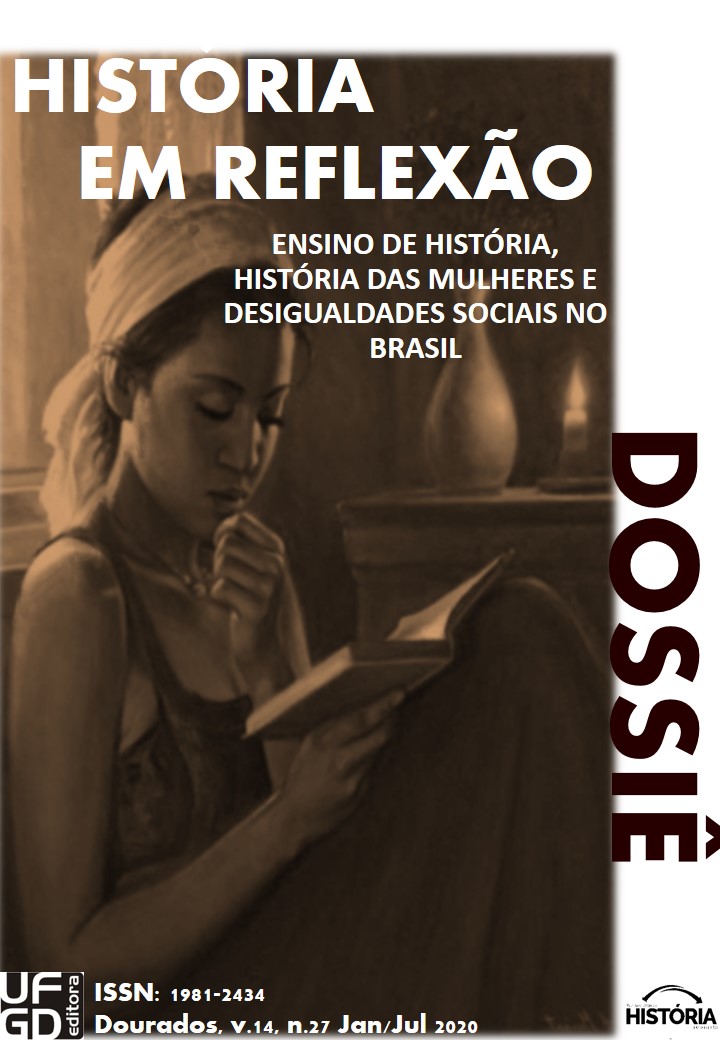
Downloads
Published
How to Cite
Issue
Section
License
Copyright (c) 2020 Revista Eletrônica História em Reflexão (REHR)

This work is licensed under a Creative Commons Attribution-NonCommercial-ShareAlike 4.0 International License.
Authors who publish in this journal accept the publication guidelines and agree to the following terms:
(a) The Editorial Board reserves the right to make changes to the originals in Portuguese to maintain the formal standard of the language, while respecting the authors' style.
(b) Authors retain copyright and grant the journal the right to first publication, with the work simultaneously licensed under the Creative Commons Atribuição-NãoComercial-CompartilhaIgual 4.0 Internacional, which allows: Share — to copy and redistribute the material in any medium or format, and Adapt — to remix, transform, and create from the material. The Creative Commons Atribuição-NãoComercial-CompartilhaIgual 4.0 Internacional includes the following terms:
- Attribution — You must give appropriate credit, provide a link to the license, and indicate if changes were made. You must do this in a reasonable manner, but not in any way that suggests the licensor endorses you or your use.
- NonCommercial — You may not use the material for commercial purposes. ShareAlike — If you remix, transform, or create from the material, you must distribute your contributions under the same license as the original.
- No additional restrictions — You may not apply legal terms or technological measures that legally restrict others from doing anything the license permits.
(c) Authors are permitted and encouraged to publish and distribute their work online—in institutional repositories, personal pages, social networks, or other scientific dissemination sites, provided that the publication is not for commercial purposes.